


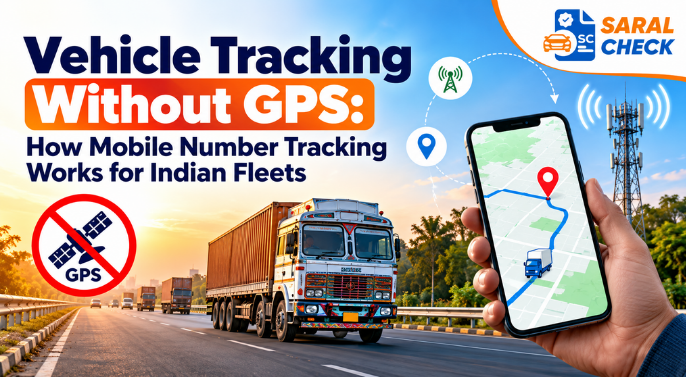
GPS-Free Vehicle Tracking: How Mobile Tracking Works in India
Vehicle tracking without GPS is a practical option for transporters who need movement updates but cannot rely on a dedicated GPS tracking device in every truck. Using an appropriate mobile number tracking service, businesses may obtain estimated trip movement information through the driver’s phone and supported mobile network data.
This approach can be useful for hired trucks, temporary vehicles, small fleets and situations where a GPS device stops reporting. It can help dispatch teams coordinate deliveries, reduce unnecessary calls to drivers and provide customers with more informed updates.
However, vehicle tracking without GPS is not the same as precise, continuous GPS tracking. Accuracy and update frequency depend on the technology, network conditions and service capabilities. Driver awareness, appropriate consent and responsible handling of location data are also essential.
In this guide, we explain how mobile number tracking works, how it compares with GPS and toll-based tracking, and how Indian transport businesses can choose the right tracking method for their operations.
What Is Vehicle Tracking Without GPS?
Vehicle tracking without GPS refers to methods of monitoring vehicle movement without depending on a dedicated GPS tracking device installed in the vehicle.
Two possible approaches are mobile number tracking and toll-based vehicle tracking.
- Mobile number tracking: Uses an authorised phone-based tracking process and supported location information to estimate movement during a trip.
- Toll-based vehicle tracking: Uses available toll plaza records to confirm a vehicle’s movement at recorded highway points.
These methods serve different purposes. Mobile tracking may provide trip-level movement information, while toll-based tracking can help confirm recent highway movement when a relevant toll record is available.
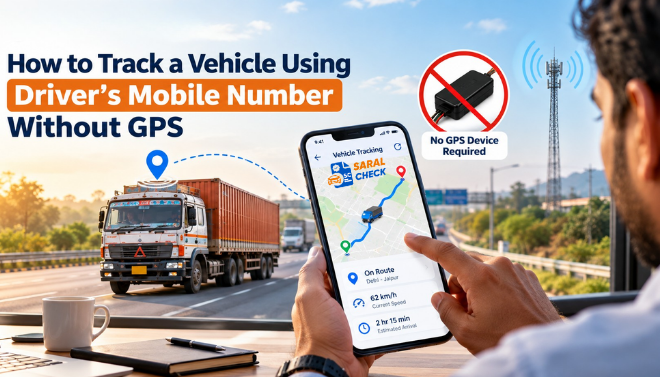
For example, imagine a transporter in Delhi hires a truck to deliver goods to Jaipur. The truck belongs to a third-party operator and does not have an installed GPS device. The transporter still needs to understand whether the trip is progressing and whether a delivery delay requires attention.
A suitable tracking service may help provide movement updates without installing dedicated GPS hardware, depending on the service’s capabilities and the information available.
It is important to remember that a vehicle registration number or an ordinary phone number does not automatically provide access to a vehicle’s live location. A legitimate tracking service needs an appropriate technical method and authorised access to the relevant information.
Why Do Transporters Need Vehicle Tracking Without GPS?
Many Indian logistics businesses use a combination of owned vehicles, hired trucks, market vehicles and third-party transport arrangements. Not every vehicle has the same tracking equipment or reporting system.
This creates several operational challenges.
1. Hired Trucks May Not Have GPS Devices
Transporters frequently arrange vehicles according to load availability, destination and delivery deadlines. A truck hired for a single trip may belong to an independent owner who has not installed a GPS tracking device.
Installing new hardware for a temporary movement may not be practical. A suitable mobile tracking service can offer an alternative when the driver agrees to tracking and the required functionality is available.
2. GPS Devices Can Stop Reporting
A GPS device may stop sending updates because of a power issue, hardware fault or connectivity problem. When this happens during a highway journey, dispatch teams may lose visibility at a critical time.
Mobile number tracking may provide a backup source of trip information while the GPS issue is investigated. It does not repair the device, and it may not provide the same level of accuracy or functionality.
3. Tracking Hardware May Not Suit Every Fleet
Small transport businesses and operators using temporary vehicles may find it impractical to install and maintain dedicated tracking equipment across every truck.
A suitable phone-based tracking service may provide another option for basic trip monitoring. Before choosing one, compare its charges, technical limitations and suitability for your operations.
4. Repeated Driver Calls Consume Time
Without reliable movement updates, dispatchers may repeatedly call drivers to ask whether the truck has departed, reached a highway, stopped for an extended period or approached the delivery location.
A centralised tracking process may reduce unnecessary follow-ups and help dispatch teams focus on delays or exceptions that need attention.
Drivers should never be encouraged to use their phones while driving. Tracking and communication procedures should support safe driving practices.
5. Customers Expect Better Delivery Updates
Customers want clear information about shipment progress and expected delivery times. When transporters lack reliable movement information, providing accurate updates becomes difficult.
Tracking can help teams communicate what is known, identify missing information and investigate potential delays before making commitments.
How Does Mobile Number Tracking Work Without GPS?
Mobile number tracking uses the driver’s phone and a tracking service’s supported location technology instead of relying exclusively on a separate GPS device installed in the truck.
Mobile phones communicate with cellular networks through nearby towers. Depending on the technology and information available to the service, network data may help estimate the phone’s location. This estimate is not necessarily as precise as a GPS location fix.
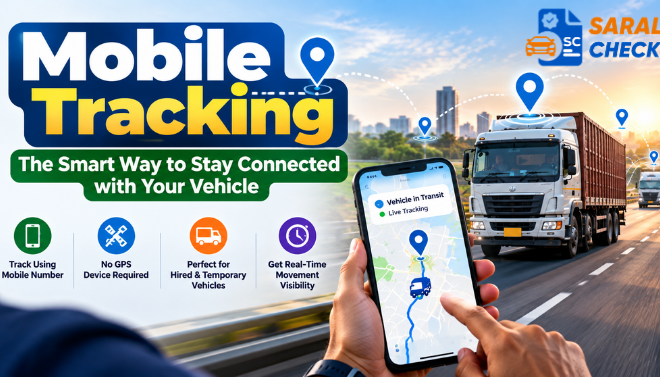
Saral Check describes its Mobile Tracking service as a way to follow vehicle movement using the driver’s mobile number and nearby mobile towers, without installing a dedicated GPS device.
Here is how the process works.
Step 1: Obtain the Driver’s Agreement
Explain why the trip needs to be monitored, what information will be used, who can access it and when tracking will stop. Obtain the necessary consent or establish another appropriate legal basis before tracking begins.
Step 2: Enter the Driver’s Details
According to Saral Check’s published workflow, the user opens the app, logs in, selects Mobile Tracking and enters the driver’s name and mobile number as required.
The service then displays available movement information according to its supported tracking process.
Step 3: The Phone Communicates With the Mobile Network
As the driver travels, the phone communicates with available cellular towers. Network coverage, phone connectivity and the technology used by the service influence whether location estimates can be produced and how frequently updates become available.
Step 4: Review Available Movement Information
The tracking service processes the information available through its supported method and displays movement updates through its interface.
Dispatchers can review these updates to understand the broad progress of a trip. They should not assume that every update identifies the truck’s exact location.
Step 5: Follow the Trip and Investigate Exceptions
Review the available information according to an agreed schedule. If movement appears inconsistent with the planned journey, follow the company’s exception-handling process.
A missing update does not automatically mean the vehicle has stopped. Weak network coverage, a discharged phone battery or a technical issue may interrupt reporting.
Step 6: Close the Tracking Session
After delivery, end the tracking session and retain only the information needed for legitimate operational purposes, in accordance with applicable requirements and company policies.
The goal is useful visibility during a business trip, not indefinite monitoring of a driver.
How to Track a Vehicle Using a Mobile Number
If you manage hired trucks, third-party vehicles or a small fleet, a suitable mobile number tracking service may help you monitor trip movement without installing a dedicated GPS device in every vehicle.
Saral Check’s published Mobile Tracking workflow includes these steps:
- Open the Saral Check app: Log in and access the available services.
- Select Mobile Tracking: Open the mobile tracking feature.
- Enter the driver’s details: Provide the driver’s name and mobile number as required by the service, after obtaining the necessary agreement.
- Review available updates: Check the movement information shown in the app and interpret it according to the service’s capabilities.
- Coordinate the delivery: Use available information to investigate delays, communicate with customers and close the tracking session after delivery.
For current feature information, visit the Saral Check Mobile Tracking page.
What Information Should You Prepare?
Before starting a tracking session, keep the following details ready:
- Driver’s name and mobile number.
- Vehicle and trip details.
- Planned origin and destination.
- Expected departure and delivery times.
- Driver’s agreement to the tracking process.
- A procedure for missing updates and unexpected delays.
These details help dispatch teams interpret movement information in the right context.
How Accurate Is Vehicle Tracking Without GPS?
The accuracy of vehicle tracking without GPS depends on the method being used.
Mobile network-based tracking generally provides an estimated location. Toll-based tracking confirms a recorded crossing at a particular toll point when the relevant record is available.
Neither method should automatically be treated as equivalent to continuous, pinpoint GPS tracking.
Factors That Affect Mobile Tracking Accuracy
Mobile tower density: Areas with more closely spaced towers may support more useful location estimates than areas with sparse network infrastructure. Actual accuracy depends on the technology and data available.
Network coverage: Poor connectivity can delay or interrupt updates.
Phone status: A switched-off phone, depleted battery or connectivity problem may prevent new location information from becoming available.
Tracking service capabilities: Different services may use different data sources, processing methods and update intervals.
Operational requirements: A broad indication of trip progress may be sufficient for a routine delivery. Precise arrival monitoring, geofencing and detailed route history may require a suitable GPS-based system.
What Can Mobile Tracking Help You Understand?
Depending on the service and available information, mobile tracking may help a dispatcher assess whether a trip appears to have started, whether movement is broadly consistent with the planned route and whether further investigation is needed.
However, it cannot reliably establish the truck’s exact position at every moment. An estimated phone location also does not prove that the vehicle is at the same location, particularly if the driver is away from the truck.
For important operational decisions, combine tracking information with appropriate verification, direct communication and relevant business records.
Mobile Number Tracking vs GPS vs Toll-Based Vehicle Tracking
Choosing the right tracking method starts with understanding what information your business needs.
| Feature | Mobile number tracking | GPS tracking | Toll-based tracking |
| Dedicated GPS device | Not required | Usually required for device-based tracking | Not required |
| Main information source | Driver’s phone and supported network data | GPS-enabled device or system | Available toll plaza records |
| Type of visibility | Estimated trip movement | Location updates according to the device and service | Recorded toll crossings |
| Update pattern | Depends on network and service | Depends on configuration and connectivity | When relevant toll events are recorded |
| Suitable use case | Hired trucks, temporary trips and GPS gaps | Detailed, ongoing fleet monitoring | Confirming recent highway movement |
| Main limitation | Accuracy, coverage and consent requirements | Hardware, maintenance and connectivity | No continuous location between recorded toll points |
Which Tracking Method Should You Choose?
For hired trucks without GPS: Consider an appropriate mobile tracking service and toll-based confirmation where available.
For GPS device failures: Investigate the device and use a suitable backup method if available.
For detailed fleet monitoring: Choose a GPS tracking system that meets your requirements for location accuracy, route history and alerts.
For recent highway movement: Toll-based vehicle tracking may help confirm recorded crossings.
For high-value shipments: Consider a risk-appropriate tracking setup with suitable alerts, escalation procedures and verification methods.
The objective is not to use one technology for every trip. It is to choose a method that provides sufficiently reliable information for the decision being made.
Benefits of Vehicle Tracking Without GPS for Indian Transporters
When used appropriately, mobile number tracking can support several everyday transport operations.
1. Monitor Hired and Market Vehicles
Transporters often arrange trucks from third-party owners to meet customer requirements. A suitable mobile tracking process can provide another source of movement information when the vehicle does not have an installed GPS device.
2. Maintain Visibility During GPS Outages
A backup tracking process may help dispatchers maintain some trip visibility while a faulty GPS device is being investigated.
However, the backup may not provide all the capabilities of the original system.
3. Reduce Unnecessary Driver Calls
When movement information is available through a centralised process, dispatch teams may need fewer routine calls to check trip status.
This can help drivers focus on safe driving and allow dispatchers to concentrate on exceptions.
4. Improve Customer Communication
Available tracking updates can help customer support teams provide more informed shipment updates and identify deliveries that require investigation.
Teams should distinguish between confirmed events and estimated locations rather than treating both as equally certain.
5. Support Small and Medium-Sized Fleets
Businesses managing a small number of vehicles or temporary transport arrangements may benefit from an additional tracking option that does not require a dedicated GPS device in every truck.
Actual cost savings depend on service charges, trip volume and operational requirements.
6. Help Brokers and Logistics Aggregators Coordinate Trips
Brokers and aggregators often coordinate vehicles belonging to multiple operators. A consistent process for tracking authorised trips can help teams share relevant updates and manage deliveries more efficiently.
Third-party vehicle ownership does not remove the need for driver awareness, consent and appropriate access controls.
7. Improve Exception Management
Tracking becomes more useful when dispatchers know what to do if an update is missing or a trip appears delayed.
For example, a dispatcher can review the last available update, check for network problems and follow the agreed contact procedure. This is more useful than treating every missing update as an emergency.
How to Use Mobile Tracking in Daily Fleet Operations
A tracking tool is most useful when it becomes part of a repeatable dispatch process.
Before Dispatch: Verify and Prepare
Confirm the relevant vehicle and driver details. Explain the tracking process, obtain the necessary agreement and record the planned route and expected delivery window.
Use appropriate vehicle verification and driver verification procedures before assigning the load.
At Departure: Confirm Trip Progress
Start the tracking session according to the service’s instructions. Review the first available updates and compare them with the planned departure.
If information does not appear as expected, check the setup and technical conditions before drawing conclusions.
During Transit: Review at Planned Intervals
Set a review schedule that matches the shipment’s urgency and risk. Routine deliveries may require periodic checks, while higher-risk shipments may need more frequent monitoring and a more capable tracking system.
Establish a clear process for handling:
- Updates missing beyond the agreed time window.
- Possible prolonged stoppages.
- Movement inconsistent with the expected route.
- Delays that affect the consignee.
- Differences between tracking information and other records.
Verify the situation before taking action based on incomplete information.
At Delivery: Close the Tracking Session
Confirm delivery through the company’s normal process, end the tracking session and record any exceptions that require follow-up.
Avoid retaining or sharing unnecessary location information after the trip has ended.
After the Trip: Review Tracking Gaps
If a trip experienced a tracking interruption, investigate whether the cause was network coverage, phone connectivity, incorrect setup or a process failure.
This helps improve operations without assuming that every technical issue reflects a driver’s actions.
Privacy and Consent in Vehicle Tracking
Vehicle tracking involving a driver’s phone requires careful handling because location information may be linked to an identifiable person.
The Digital Personal Data Protection Act, 2023, and other applicable requirements may be relevant depending on the circumstances and the law in force. Businesses should seek qualified legal advice about their specific obligations.
Follow these responsible tracking practices:
- Inform the driver: Explain the purpose of tracking, the information involved and the expected duration.
- Obtain the necessary consent or establish another appropriate legal basis: Do not assume that providing a phone number automatically authorises location monitoring.
- Limit tracking to the relevant trip: Avoid unnecessary monitoring outside the agreed operational purpose.
- Restrict access: Allow only authorised personnel to view tracking information.
- Set retention rules: Define how long records are kept and when they should be deleted, subject to applicable requirements.
- Protect the information: Use suitable access controls and security procedures.
- Explain technical limitations: Make sure staff understand that missing updates may result from connectivity problems.
Responsible tracking can improve coordination while helping businesses maintain trust with drivers.
This section provides general information, not legal advice.
Why Vehicle Tracking Should Be Combined With Verification
Knowing where a vehicle appears to be is only one part of transport management. Businesses also need to check relevant vehicle and driver information before dispatch.
Tracking and verification serve different purposes.
| Operational question | Relevant process |
| Who is assigned to the trip? | Driver verification and dispatch records |
| Is the vehicle information valid? | Vehicle verification |
| What movement information is available during transit? | Mobile tracking or GPS |
| Has the vehicle crossed a highway toll point? | Toll-based vehicle tracking |
| Are there pending traffic challans to review? | e-Challan check |
For example, a transporter arranging a truck for an urgent load can verify the vehicle and driver before dispatch, choose an appropriate tracking method during the journey and review relevant records afterwards.
This creates a more complete operational workflow than relying on location updates alone.
Saral Check provides separate services for mobile tracking, vehicle tracking and vehicle-related checks. Explore its official website to understand the available services and their specific functionality.
Common Mistakes to Avoid When Tracking Vehicles Without GPS
Expecting Exact GPS-Level Accuracy
Mobile network-based tracking may provide estimated location information rather than a precise position.
What to do: Use mobile tracking for suitable trip-level questions and choose GPS when precise location information is essential.
Assuming Every Mobile Number Can Be Tracked
A phone number is not a universal live-location lookup tool.
What to do: Use an appropriate, authorised tracking service and follow its documented process.
Ignoring Network Coverage
Poor connectivity can delay or interrupt updates.
What to do: Establish a reasonable check-in procedure and an agreed period before escalating a missing update.
Tracking Without Informing the Driver
Unexplained tracking can create privacy concerns and damage trust.
What to do: Explain the purpose, tracking period and access rules before the trip begins.
Treating Missing Updates as Proof of Misconduct
A missing update may reflect network conditions, a phone problem or a service interruption.
What to do: Verify the situation using appropriate sources before taking action.
Using One Method for Every Shipment
A local delivery, a long highway journey and a high-value shipment may need different levels of visibility.
What to do: Match the tracking method to the route, risk, vehicle ownership and delivery requirements.
Leaving Tracking Active After Delivery
Tracking should have a defined purpose and end point.
What to do: Close the session after the trip and follow the organisation’s data-retention policy.
Frequently Asked Questions
Yes. Suitable alternatives include authorised mobile number tracking and toll-based vehicle tracking. Mobile tracking uses the driver’s phone and supported location information, while toll-based tracking uses available records of highway crossings. Each method provides a different type of visibility.
You can use a supported mobile tracking service that allows authorised trip tracking through the driver’s mobile number. In Saral Check’s published workflow, you open the app, log in, select Mobile Tracking and enter the driver’s details as required. Obtain the necessary consent before tracking begins.
Accuracy depends on the method used. Mobile network-based tracking generally provides estimated location information, while toll-based tracking confirms recorded crossing events. Neither should automatically be treated as equivalent to precise, continuous GPS tracking.
Update frequency depends on the service and network conditions. Poor coverage or phone connectivity issues may delay or interrupt updates. Check the service’s actual capabilities before relying on it for time-sensitive decisions.
A suitable mobile number tracking service may provide trip visibility for a hired truck without requiring a dedicated GPS device. This can be useful for temporary vehicles and market trucks, subject to the service’s capabilities and the necessary driver consent.
Mobile tracking uses a phone-based process to estimate movement during a trip. Toll-based tracking uses available toll plaza records to confirm recorded highway crossings. Toll-based tracking does not provide continuous location information between those recorded events.
The answer depends on the circumstances, the information being processed and the applicable legal requirements. Businesses should define the purpose, inform drivers, obtain the necessary consent or establish another appropriate legal basis, and restrict access to location data. Consult a qualified legal adviser for your specific situation.
If the phone is switched off or cannot communicate with the required network, new location updates should not be expected. The service may display the last available information if that feature is supported, but it does not establish the vehicle’s current position.
Conclusion: Choose the Right Vehicle Tracking Method for Every Trip
Vehicle tracking without GPS gives Indian transport businesses another way to maintain trip visibility when a dedicated tracking device is unavailable. Mobile number tracking may be particularly useful for hired trucks, temporary transport arrangements, small fleets and situations where a GPS device has stopped reporting.
However, no single tracking method is suitable for every operational requirement. Mobile tracking provides estimated movement information through an appropriate phone-based process. GPS is generally better suited to precise, continuous monitoring, while toll-based tracking can confirm recorded highway movement at available toll points.
For better results, build tracking into a wider workflow: verify the driver and vehicle before dispatch, choose an appropriate tracking method, establish procedures for missing updates, respect driver privacy and close the tracking session after delivery.
Need to track vehicle movement without installing a GPS device?
Explore Saral Check Mobile Tracking to learn how mobile number tracking can support your transport operations. If you need to review recent highway movement through toll records, explore Saral Check Vehicle Tracking.
Choose the method that fits your trip, understand its limitations and use movement information responsibly.