





India’s 100 Lakh Crore Logistics Vision: A New Direction for Faster and More Reliable Freight Movement
India’s logistics sector is entering a decisive phase. With the government’s ambitious PM Gati Shakti initiative and an infrastructure push of over ₹100 lakh crore, the country is building the foundation for a faster, more connected supply chain ecosystem.
Highways are expanding. Freight corridors are improving. Multimodal connectivity is becoming a reality.
From a broader perspective, the direction is clear – India is preparing for a long-term logistics growth cycle.
But beneath this momentum lies a more important reality.
Infrastructure may enable movement. But execution determines efficiency.
A Structural Shift in India’s Logistics Landscape
For years, logistics inefficiencies in India were largely linked to physical limitations such as poor road connectivity, congestion at toll plazas, and fragmented transport networks.
That narrative is now changing.
With large-scale investments and policy alignment, many of these bottlenecks are being addressed. Travel time is reducing, route predictability is improving, and freight movement is becoming faster.
This shift is creating opportunities not only for logistics companies but for the entire supply chain ecosystem.
However, as physical infrastructure improves, a new challenge is becoming increasingly visible – operational reliability.
Where Most Logistics Disruptions Actually Begin
Contrary to popular perception, most logistics disruptions do not originate on highways.
They begin at the point of execution.
A shipment may be planned efficiently. A vehicle may be booked quickly. Dispatch timelines may be aligned.
And yet, small operational inconsistencies can create major downstream issues.
- A vehicle arrives that does not match the assigned details
- Driver credentials are unclear or inconsistent
- Documentation is incomplete during dispatch
- Verification steps are skipped in the rush to move faster
Individually, these gaps may appear minor.
But in a high-speed logistics environment, they can quickly lead to delays, disputes, operational inefficiencies, and loss of trust.
The New Risk of a Faster System
As logistics becomes faster, the margin for error becomes smaller.
In slower systems, inefficiencies were often absorbed within longer timelines. In a high-speed environment, errors travel just as quickly as shipments.
A single mismatch at the start of a journey can result in:
- Delayed deliveries
- Increased operational costs
- Communication breakdowns
- Reduced confidence between stakeholders
This creates an important shift in how logistics efficiency must be understood.
Speed alone does not reduce risk. In many cases, it amplifies it.
From Movement to Reliability: The Next Phase of Logistics
India’s logistics transformation is now moving beyond infrastructure.
The next phase will be defined by how reliably operations are executed at scale.
Businesses are no longer evaluating logistics performance only through transit time. Increasingly, they are focusing on:
- Accuracy of execution
- Consistency of processes
- Trust in operational data
This reflects a deeper maturity in the logistics ecosystem.
Because in logistics, predictability is just as valuable as speed.
Why Verification Is Becoming Central to Logistics Efficiency
To support this shift, the industry is increasingly recognizing the importance of structured verification systems.
Verification is no longer only a compliance requirement – it is becoming a core operational function.
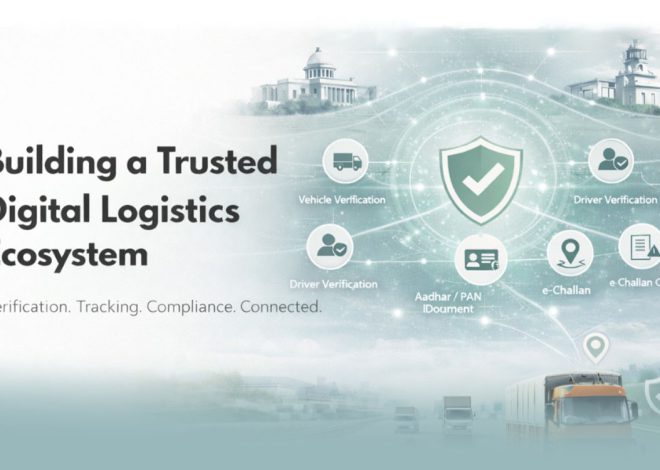
Effective logistics operations now depend on ensuring that:
- The correct vehicle is assigned
- Driver identities match verified records
- Documentation is complete and accurate
- Operational data is validated before dispatch
These steps may not directly accelerate movement.
But they help ensure that movement happens without friction.
The Role of Digital Systems in Strengthening Execution
As logistics operations continue to scale, manual processes are becoming increasingly insufficient.
The need is shifting toward systems that can bring consistency, visibility, and validation into day-to-day operations.
Digital platforms are helping bridge this gap by enabling structured workflows and reducing dependency on fragmented information.
In this evolving environment, solutions like Saral Check are emerging as part of the broader logistics ecosystem by supporting operational verification and execution clarity.
Their role is not to replace existing logistics processes, but to strengthen them.
By ensuring that critical checks happen before dispatch, such systems help reduce uncertainty and improve operational reliability.
Infrastructure Alone Cannot Deliver Efficiency
The scale of India’s infrastructure push is undeniable. It is creating the physical backbone required for faster freight movement.
But infrastructure alone cannot guarantee efficiency.
Without strong execution systems:
- Errors will continue to occur
- Delays will persist in different forms
- Risks will shift rather than disappear
True efficiency exists at the intersection of infrastructure and systems.
Infrastructure enables speed.
Systems ensure accuracy.
Together, they define performance.
Looking Ahead: Building a More Reliable Logistics Ecosystem
India’s logistics sector is clearly moving in the right direction. The intent, investment, and momentum are aligned.
But as the ecosystem grows, the focus must expand beyond building faster networks to building more reliable operations.
Because in a high-speed logistics environment, even the smallest operational gap can create a major impact.
The future will belong to systems that not only move goods efficiently, but move them with precision, consistency, and trust.
India’s ₹100 lakh crore logistics push is a transformative step forward. It creates the foundation for faster movement, stronger connectivity, and long-term growth.
But the true success of this transformation will not be measured only by how quickly goods travel across highways.
It will be measured by how seamlessly they move through the system.
Because in the end, logistics efficiency is not just about speed.
It is about getting it right – every single time.