

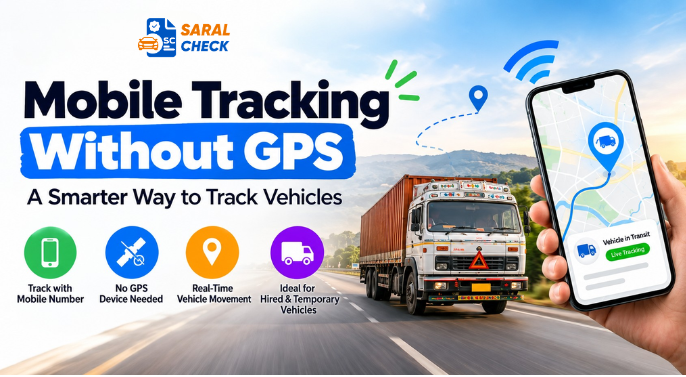
Mobile Tracking Without GPS: How It Works
Tracking a truck during a delivery should not always require installing a dedicated GPS device. For transporters, fleet owners, and logistics companies working with hired vehicles, a mobile-based tracking service can offer another way to obtain vehicle movement information.
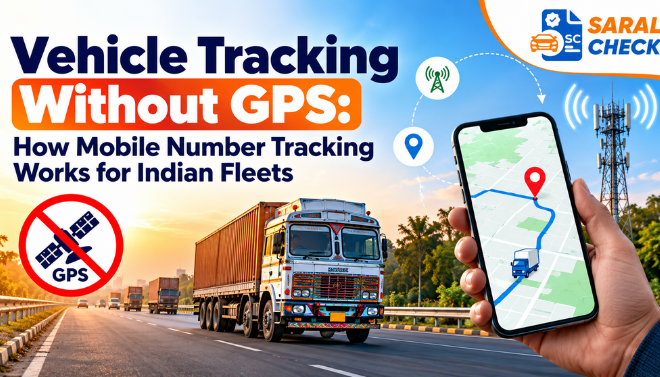
Mobile tracking without GPS refers to tracking a vehicle’s movement without requiring a separate GPS tracking device installed in the vehicle. Depending on the service, location information may be obtained through mobile network data, smartphone location services, or another supported tracking method.
For Indian transport businesses, this approach can be useful when a hired truck does not have accessible GPS hardware or when installing a separate device for a temporary trip is impractical.
In this guide, we explain how mobile tracking works, how it compares with traditional GPS tracking, what transporters should know about accuracy and privacy, and how SaralCheck Mobile Tracking can support vehicle movement monitoring.
What Is Mobile Tracking Without GPS?
Mobile tracking without GPS is a method of obtaining vehicle movement information through a driver’s mobile phone and an appropriate tracking service, without installing a separate GPS tracking device in the vehicle.
It can help transport businesses obtain movement updates for eligible trips when a dedicated vehicle tracker is unavailable or inaccessible.
For example, imagine a transporter in Delhi who receives an urgent delivery order for Jaipur. The regular fleet is occupied, so the transporter hires a truck from another vehicle owner. The hired truck may not have a tracking device that the transporter can access.
In this situation, a supported mobile tracking service may provide an alternative way to obtain movement information, subject to the driver’s authorization and the service’s technical requirements.
This can make vehicle monitoring more flexible for businesses that regularly work with temporary vehicles, third-party transporters, or additional trucks during busy periods.
What does “without GPS” actually mean?
The phrase usually means that a separate GPS tracking device installed in the vehicle is not required for the supported tracking process.
It does not necessarily mean that GPS technology is never used. A smartphone may use satellite-based positioning alongside mobile networks and other location technologies.
The exact method depends on the tracking service.
Before choosing a solution, businesses should confirm how location information is obtained, what permissions are required, how frequently updates are available, and how accurately the service can estimate a vehicle’s position.
Why Do Transporters Need Mobile Tracking Without GPS?
Vehicle tracking requirements vary between transport businesses.
A company operating its own fleet may have dedicated GPS devices installed in its trucks. A transporter who arranges vehicles from the open market may not have access to the same hardware or tracking platforms.
Several common challenges make mobile-based tracking worth considering.
1. Hired trucks may not have accessible GPS
Transporters frequently arrange vehicles from external owners to fulfil customer orders. Even when a truck has a GPS device, the transporter may not have access to its tracking system.
In other cases, the truck may not have a dedicated tracking device at all.
A suitable mobile tracking service can offer another option for eligible trips, helping transporters obtain movement information without depending entirely on access to a third-party GPS platform.
2. Installing hardware for temporary trips may be impractical
Dedicated vehicle tracking devices can require procurement, installation, configuration, power connections, and maintenance.
These arrangements may be appropriate for a permanent fleet, but they can be inconvenient for a vehicle hired for a single delivery.
Mobile-based tracking may reduce the need for separate hardware installation for every eligible trip.
3. Repeated calls consume time
When a dispatcher cannot access tracking information, the usual solution is to call the driver for updates.
Frequent calls can interrupt work and take time away from dispatch planning, customer communication, and delivery coordination.
A suitable tracking service can reduce some routine follow-ups by making available movement information easier to access.
Direct communication remains important when a dispatcher needs to confirm an unexpected delay, a loading issue, or the actual completion of a delivery.
4. Businesses work with different vehicle types
A logistics business may use owned trucks, hired vehicles, attached vehicles, and third-party transport partners.
Not every vehicle will have the same tracking equipment or platform.
Mobile tracking can complement an existing GPS system by providing an additional option for suitable trips that are not connected to the primary tracking platform.
5. Customers want better delivery updates
Customers often ask whether goods have been dispatched, where a shipment may be, and when it might arrive.
Movement information can help transport teams communicate more clearly and investigate delays.
However, an approximate location should not be presented as a confirmed arrival time. Businesses should explain what the tracking system can and cannot verify.
How Does Mobile Tracking Without GPS Work?
The process depends on the tracking provider’s technology. Mobile network-based location estimation and smartphone location services are different methods, and they should not be treated as identical.
A general mobile-based tracking workflow may involve the following steps.
Step 1: Identify the driver
The tracking process begins by identifying the relevant driver through the service’s supported workflow.
A registered mobile number may be used to associate the driver with a trip. A phone number alone, however, does not provide unrestricted access to a person’s live location.
Step 2: Activate the tracking process
The user follows the provider’s prescribed steps to initiate or associate tracking with the selected driver and trip.
Depending on the service, this may involve a mobile application, location permissions, network-based location information, or other technical requirements.
Step 3: Obtain available location information
The driver’s phone communicates with mobile networks and may use its own location capabilities, depending on the tracking method.
Network-derived location estimates can be less precise than suitable smartphone GPS positioning. Actual performance varies with the environment, network availability, and service implementation.
Step 4: Process and display movement information
The tracking service processes available information and displays it through its supported interface.
Depending on the product, the information may include an approximate location, movement updates, or other trip-related details.
Businesses should confirm the specific features provided rather than assuming every mobile tracking service offers the same functionality.
Step 5: Use updates to coordinate the trip
Transport managers can use available movement information to coordinate with drivers, respond to customer enquiries, and identify when further confirmation may be needed.
Tracking information supports operational decisions, but it should not replace direct communication when a situation requires verification.
Mobile Tracking Without GPS vs Traditional GPS Tracking
Mobile-based tracking and dedicated GPS tracking address related needs, but they are not interchangeable in every situation.
GPS uses satellite signals that a suitable receiver processes to determine its position. A dedicated vehicle tracking system can combine positioning with communication, mapping, and fleet-management features.
Mobile-based tracking depends on the driver’s phone and the location method used by the service.
The following comparison can help transport businesses evaluate their options.
| Factor | Mobile-based tracking | Dedicated GPS tracking |
| Separate vehicle device | Not required for supported workflows | Usually required |
| Vehicle installation | May not require installation | Typically requires installation |
| Suitable applications | Eligible hired and temporary trips | Permanent fleet monitoring |
| Location method | Depends on the provider | Satellite positioning through the tracking device |
| Accuracy | Varies by technology and conditions | Often provides precise positioning when functioning correctly |
| Hardware management | Less dependence on vehicle-mounted hardware | Device maintenance and configuration may be needed |
| Driver phone dependency | Usually important | Depends on the system |
| Best use | Flexible tracking for eligible trips | Continuous monitoring and detailed fleet requirements |
Which tracking method should you choose?
The right choice depends on your business requirements.
Dedicated GPS tracking may be more suitable when you need continuous vehicle-level monitoring, detailed route history, or a tracking device that operates independently of the driver’s personal smartphone.
Mobile-based tracking may be more practical when you need movement visibility for hired vehicles or temporary trips where dedicated tracking hardware is unavailable or inaccessible.
Many transport businesses can use both methods. GPS can support permanent fleet monitoring, while mobile tracking can help cover eligible vehicles that are not connected to the main tracking platform.
Key Benefits of Mobile Tracking Without GPS
Mobile tracking can help transport businesses improve visibility while reducing their dependence on dedicated vehicle hardware.
Less dependence on additional hardware
Installing a separate tracker in every temporary or hired vehicle may not be practical.
A supported mobile tracking service can provide an alternative for eligible trips without requiring another vehicle-mounted device.
This can be especially relevant for transporters who regularly arrange vehicles from the open market.
Easier coordination with hired vehicles
When a transporter hires a truck, control over its equipment and tracking platform may be limited.
Mobile-based tracking can offer another way to obtain movement information when the driver and vehicle meet the service’s requirements.
This can make coordination easier for businesses working with multiple transport partners.
Reduced routine follow-ups
Repeated calls asking for location updates can consume time for both drivers and dispatchers.
A suitable tracking interface can reduce some routine follow-ups by making available movement information easier to access.
Important events, unusual delays, and delivery confirmations may still require direct communication.
More flexible trip management
Mobile tracking may be useful for one-time loads, temporary assignments, and vehicles brought into the operation at short notice.
Businesses do not necessarily need to make the same hardware arrangements for every trip.
This flexibility can be valuable when vehicle demand changes from day to day.
Better customer communication
Customers often want updates about dispatch, transit, and delivery.
Available tracking information can help transport teams provide more informed responses and investigate possible delays.
Businesses should communicate the level of certainty accurately. An estimated location is not the same as a confirmed arrival time.
An additional option for mixed fleets
A transport business may not own every vehicle it dispatches.
Mobile tracking can help address some visibility gaps between permanent fleet vehicles and temporary transport arrangements.
It can be one part of a broader process for monitoring trips across different vehicle categories.
Who Can Benefit from Vehicle Tracking Without GPS?
Mobile-based tracking can be useful for different types of businesses, depending on their vehicle arrangements and tracking requirements.
Transporters
Transporters arranging trucks for multiple customers need to coordinate pickups, transit, and deliveries.
Mobile tracking can provide another option for obtaining movement information when a hired vehicle does not have accessible GPS hardware.
Fleet owners
Fleet owners may already use GPS devices in their regular vehicles but hire additional trucks during busy periods.
Mobile-based tracking can complement their existing systems for eligible temporary trips.
Logistics companies
Logistics teams often coordinate shipments, routes, and transport partners across different locations.
A suitable mobile tracking service may help provide visibility for vehicles that are not connected to the company’s primary tracking platform.
Transport brokers
Brokers coordinate loads between customers and independent vehicle owners.
Where appropriate authorization is in place, mobile tracking can help brokers obtain movement information for active trips without installing hardware in a third-party vehicle.
Shippers and businesses moving goods
Manufacturers, distributors, wholesalers, and other businesses may need updates about goods in transit.
Tracking information can support communication with transport providers and help teams follow up when a shipment appears delayed.
Small and medium-sized transport businesses
Smaller operators may need tools that fit their existing fleet structure and budget.
Mobile-based tracking is worth evaluating when dedicated hardware for every vehicle is impractical.
Practical Use Cases Across Indian Transport and Logistics
India’s transport ecosystem includes permanent fleets, independent truck owners, local delivery operators, and vehicles hired for individual loads.
These different operating models create different tracking needs.
Tracking a last-minute truck booking
A transporter in Ghaziabad receives a load for Jaipur but has no available truck in the regular fleet.
The transporter arranges a vehicle through another operator. The truck does not have a GPS dashboard that the transporter can access.
A supported mobile tracking service may provide an alternative way to obtain movement information, subject to the service’s requirements and the driver’s authorization.
This can help the dispatcher coordinate the trip without relying entirely on repeated phone calls.
Managing extra vehicles during peak demand
A distribution business experiences a temporary increase in deliveries during a festival or sales period.
Its regular fleet cannot handle every order, so the business hires additional vehicles.
The operations team can evaluate mobile-based tracking for eligible vehicles rather than assuming that every hired truck has compatible GPS hardware.
This creates flexibility when arranging temporary transport capacity.
Coordinating multiple transport partners
A logistics company works with several external transporters across different routes.
Some partners provide access to their tracking platforms, while others do not.
Mobile tracking may help cover some of these gaps, provided the required authorization and technical conditions are met.
The goal is to improve trip visibility while respecting each driver’s privacy and the vehicle owner’s control over their systems.
Monitoring local delivery trips
A distributor sends goods to retailers across several nearby locations.
Some delivery vehicles may be hired temporarily or may not have accessible GPS hardware.
Where supported, mobile tracking can provide additional trip information and help the operations team coordinate deliveries.
For detailed route optimization, driver performance analysis, or precise arrival prediction, the business may need a more comprehensive fleet-management solution.
Can You Track a Vehicle Using Only a Mobile Number?
A mobile number can be used as an input to an authorized tracking workflow, but a phone number alone does not provide unrestricted access to a person’s live location.
A legitimate tracking service needs an appropriate technical method to obtain location information. Depending on the service, this may involve an application, smartphone location permissions, mobile network-derived information, or another authorized mechanism.
There is an important difference between using a mobile number within a tracking product and attempting to locate someone without their knowledge or permission.
For transport businesses, the recommended approach is to use an established service, explain the tracking process to the driver, obtain the required authorization, and follow applicable privacy and data-protection requirements.
Before starting a trip, confirm the following:
- The driver understands what tracking information will be collected.
- The service supports the driver’s device and network conditions.
- Required app permissions and activation steps are completed.
- Location information is used only for the stated operational purpose.
- Access to tracking data is limited to authorized people.
These steps help businesses use tracking as an operational tool while respecting drivers’ privacy.
How Accurate Is Mobile Tracking Without GPS?
Accuracy depends on the location technology used by the provider.
Some mobile-based tracking methods estimate location using mobile network information. Others use location capabilities built into the smartphone. These approaches can produce different results.
Mobile network-derived location may be less precise than suitable device-based GPS positioning, although actual performance varies by implementation and environment.
Accuracy and update frequency may be affected by:
- The availability and quality of mobile network coverage.
- The number and distribution of nearby network towers.
- Buildings, terrain, and other environmental conditions.
- Phone settings and permissions.
- Battery-saving restrictions and background activity.
- The tracking service’s technical design.
- The time elapsed since the last location update.
Transport businesses should evaluate a tracking service under realistic operating conditions.
If your operation requires precise vehicle positioning, detailed route records, or strict service-level commitments, ask the provider about measured accuracy, update frequency, data retention, and known limitations before relying on it.
What Are the Limitations of Mobile Tracking Without GPS?
Mobile tracking offers flexibility, but it is not a perfect solution for every tracking requirement.
Dependence on the driver’s phone
If the tracking process relies on a smartphone, a switched-off phone, depleted battery, disabled permissions, or unsupported device can interrupt updates.
A dedicated vehicle tracker may be more appropriate when monitoring must continue independently of the driver’s personal phone.
Mobile network coverage
A phone may lose connectivity in certain areas or experience weak signals.
When a tracking service depends on network connectivity, missing or delayed updates may occur.
Businesses should understand how the platform handles unavailable data and whether it displays the time of the last update.
Variable location precision
Not all tracking methods provide the same level of accuracy.
An approximate location may be enough for general trip coordination, but it may not satisfy applications that require precise positioning or detailed route evidence.
Limited fleet-management functionality
Vehicle tracking is only one part of fleet management.
Some businesses also need fuel monitoring, driver behaviour reports, geofencing, route optimization, temperature monitoring, maintenance alerts, or integration with dispatch systems.
A mobile tracking service should not be assumed to include these capabilities unless the provider confirms them.
Privacy and authorization
Location information can be sensitive.
Businesses should communicate their tracking practices clearly, collect only the information needed for legitimate purposes, protect access, and establish appropriate retention policies.
Tracking should not be used to secretly monitor a driver outside the authorized work-related purpose.
Compliance requirements
Certain operations may require specific tracking equipment, records, or monitoring arrangements under applicable rules or contractual obligations.
Mobile-based tracking should not be treated as an automatic substitute for a required system. Businesses should verify the requirements that apply to their vehicles and operations.
How to Choose the Right Mobile Tracking Solution
Before selecting a mobile tracking platform, evaluate its capabilities against your real operating requirements.
Understand the location method
Ask whether the service uses smartphone location services, mobile network-based estimates, or another method.
Understanding the technology helps you set realistic expectations about accuracy and coverage.
Confirm activation requirements
Find out how a trip is started, what information is needed, whether the driver must use an app, and which permissions are required.
The process should be easy for authorized users to understand and follow.
Review update frequency
A tracking product may provide live, periodic, or event-based updates.
Ask how frequently the service updates location information under normal conditions and what happens when connectivity is interrupted.
Do not assume continuous real-time updates unless the provider confirms them.
Evaluate compatibility
Check which devices, operating systems, mobile networks, and vehicle types are supported.
If your business frequently hires vehicles, test the process with the types of drivers and phones used by your transport partners.
Understand privacy and security
Review how the service handles location information, who can access it, how data is protected, and how long records are retained.
The platform should support appropriate access controls and transparent tracking practices.
Compare the total cost
Consider subscription charges, hardware costs where applicable, setup, support, and any additional fees.
Mobile-based tracking may reduce hardware requirements for eligible trips, but the overall cost depends on the provider and service arrangement.
Test before scaling
Run a trial with representative vehicles and routes.
Check whether updates arrive as expected, whether the location display is understandable, and how easily dispatchers can act on the information.
A practical trial is more useful than choosing a product based only on broad marketing claims.
How to Use SaralCheck Mobile Tracking
SaralCheck offers a mobile tracking service designed to help transport businesses obtain vehicle movement information using the driver’s registered mobile number, without requiring a separate GPS tracking device for its supported workflow.
The service page describes a process involving the SaralCheck app, the Mobile Tracking feature, and the driver’s details.
Follow the current in-app instructions because interface details and service requirements may change.
Step 1: Open the SaralCheck app
Access the SaralCheck app and sign in using the supported login process.
Step 2: Select Mobile Tracking
Navigate to the Mobile Tracking feature in the app.
Step 3: Enter the required driver details
Provide the driver’s mobile number and any other information requested by the service.
Ensure that you have the necessary authorization to initiate tracking.
Step 4: Follow the activation process
Complete any additional steps required to establish the tracking session.
The availability of tracking information may depend on service configuration, connectivity, and other technical requirements.
Step 5: Review the available movement updates
Use the information displayed by SaralCheck to support trip coordination and communication.
Check the timestamp of the latest update and confirm important delivery milestones directly when required.
For complete service details, visit the SaralCheck Mobile Tracking page.
Why Consider SaralCheck for Mobile Tracking?
Transport businesses need practical tools that fit their daily operations.
When a hired vehicle lacks accessible GPS hardware, arranging a separate tracking device may not be feasible for every trip.
SaralCheck Mobile Tracking is designed to provide an alternative for supported vehicle-tracking situations.
The service page highlights mobile-number-based tracking without a separate GPS device for the supported workflow.
This approach may be useful for transporters, fleet owners, brokers, and logistics businesses that work with different vehicles.
Before using the service for important operations, confirm supported devices, tracking availability, location accuracy, update frequency, privacy arrangements, and applicable service charges.
The goal is to select a tracking method that improves visibility while matching the level of reliability and detail your business needs.
Frequently Asked Questions About Mobile Tracking Without GPS
1. What is mobile tracking without GPS?
Mobile tracking without GPS is a way to obtain vehicle movement information through a driver’s mobile phone and a supported tracking service without installing a separate GPS tracking device in the vehicle. The precise location method depends on the provider.
2. Can I track a vehicle using a mobile number?
A mobile number can be used as an input to an authorized tracking workflow. However, the number alone does not provide unrestricted access to a person’s live location. A suitable tracking mechanism and the necessary authorization are required.
3. Does mobile tracking require a GPS device?
Not necessarily. Supported mobile tracking services can operate without a dedicated GPS device installed in the vehicle. Their technical requirements depend on how the service obtains and processes location information.
4. Is mobile tracking the same as GPS tracking?
No. GPS-based tracking uses satellite signals processed by a suitable receiver, while mobile-based tracking may use smartphone location capabilities, mobile network information, or other methods. Accuracy and functionality vary by implementation.
5. Is mobile tracking accurate?
Accuracy depends on the technology, network conditions, device settings, and surrounding environment. Network-derived location may provide a general area rather than precise coordinates. Businesses should confirm the provider’s claims and test the service on representative routes.
6. Can I use mobile tracking for a hired truck?
Yes, if the vehicle and driver meet the tracking service’s requirements and the necessary authorization is in place. This can be useful when the hired truck does not have a dedicated GPS tracker that the transporter can access.
7. Does mobile tracking work without an internet connection?
You should not assume that it does. The service may require mobile network connectivity, internet access, or another communication method to obtain or transmit updates. Check the provider’s requirements and how it handles connectivity interruptions.
8. Can mobile tracking replace a dedicated GPS tracker?
It can be an alternative for some trips, but it may not replace GPS for every application. Continuous fleet monitoring, detailed route history, and vehicle-level reporting may require dedicated hardware or a more comprehensive tracking system.
9. Can mobile tracking help if a GPS device stops working?
It may provide an alternative source of movement information if the mobile tracking service and the driver’s phone are functioning. It is not guaranteed to work in every GPS failure scenario, so businesses should test their backup process beforehand.
10. Who should consider mobile tracking without GPS?
Transporters, fleet owners, logistics companies, brokers, shippers, and businesses that regularly use hired or temporary vehicles may benefit when they need movement visibility without installing dedicated hardware for every trip.
11. Is it legal to track a driver’s mobile phone?
Tracking should be conducted with an appropriate lawful basis, clear notice, necessary authorization, and suitable privacy safeguards. Requirements depend on the circumstances and applicable law. Businesses should avoid unauthorized or covert personal tracking.
12. How can I get started with SaralCheck Mobile Tracking?
Visit the SaralCheck Mobile Tracking service page to review the service and its requirements. Follow the current app instructions and confirm compatibility, authorization, and tracking availability before starting a trip.
Conclusion: Improve Vehicle Visibility Without GPS Hardware for Every Trip
Not every transport operation has the same tracking requirements. A permanent fleet may benefit from dedicated GPS hardware, while a transporter working with hired or temporary vehicles may need a more flexible option.
Mobile tracking without GPS offers an alternative way to obtain vehicle movement information through a driver’s mobile phone and an appropriate tracking service. It can help businesses coordinate trips, reduce routine follow-ups, and improve communication when a dedicated GPS tracker is unavailable or inaccessible.
However, the technology has limitations. Location accuracy, update frequency, mobile connectivity, device compatibility, and privacy requirements should all be considered before selecting a solution.
For transporters and logistics businesses seeking another way to monitor eligible trips, SaralCheck Mobile Tracking is worth evaluating.
Explore the SaralCheck Mobile Tracking service to learn how the workflow fits your transport operations.
Better visibility starts with choosing the right tracking method for the right vehicle and trip.